

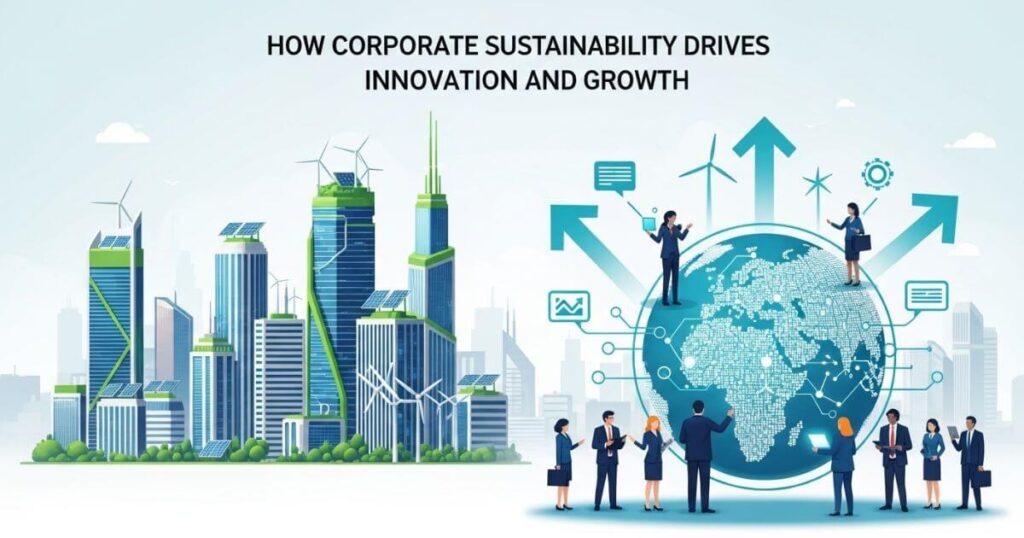
In today’s evolving business landscape, corporate sustainability is no longer just a buzzword or a checkbox on a CSR report. It has become a core driver of innovation, long-term growth and competitive advantage. Companies that once viewed sustainability as a cost center are now recognizing its strategic value — not only for the planet and society, but for their own bottom line. The shift reflects a deeper understanding: operating responsibly and efficiently can unlock new markets, inspire product development and future-proof business models in an increasingly eco-conscious world.
Corporate sustainability, at its core, is about aligning business operations with environmental, social and governance (ESG) principles. It involves rethinking everything from energy use and supply chains to labor practices and waste management — with the goal of creating long-term value for both the company and its stakeholders.
Table of Contents
How Corporate Sustainability Drives Innovation and Growth
From Obligation to Opportunity
Traditionally, corporate sustainability efforts were reactive, designed to comply with regulations or minimize reputational risk. But in recent years, the narrative has shifted. Sustainability is now seen as a source of opportunity — a means to innovate, cut costs, engage consumers and stay ahead of market disruptions.
Take, for example, companies that invest in energy-efficient technologies. What starts as a way to reduce emissions can also lead to lower operating costs, greater energy resilience and a reputation for environmental leadership — all of which contribute to improved performance and profitability.
Innovation Rooted in Responsibility
One of the most powerful aspects of corporate sustainability is its ability to spark innovation. By challenging companies to operate more responsibly, sustainability pushes them to rethink outdated processes and develop smarter, more efficient ways of doing business.
Here’s how sustainability drives innovation across industries:
1. Product Design
Eco-conscious consumers are demanding cleaner, safer and more sustainable products. Companies that respond to this demand often end up developing entirely new product lines — whether through biodegradable materials, recyclable packaging, or modular designs that extend product lifespans.
2. Process Improvement
To meet sustainability targets, businesses often reassess manufacturing, logistics and operational workflows. This leads to innovations like closed-loop systems, just-in-time delivery, or water-saving technologies — all of which reduce resource consumption while increasing productivity.
3. Technology Adoption
Corporate sustainability goals often encourage the adoption of digital tools such as IoT sensors, AI-powered analytics and blockchain for supply chain transparency. These technologies not only support sustainability but also improve decision-making and operational agility.
4. Business Model Evolution
Subscription models, product-as-a-service platforms and circular economy strategies have all emerged from the push for more sustainable business practices. These models extend product life cycles, reduce waste and create new revenue streams.
Driving Growth Through Stakeholder Engagement
Sustainability is not just about what a company does internally — it’s also about how it engages with the broader ecosystem of stakeholders, including customers, investors, employees, and communities.
- Customers are increasingly choosing brands that reflect their personal values. Businesses that demonstrate authentic commitments to corporate sustainability often build stronger brand loyalty and customer retention.
- Investors are paying closer attention to ESG performance. Many institutional investors now factor sustainability into their decision-making, rewarding companies that manage environmental and social risks responsibly.
- Employees, especially younger generations, want to work for organizations that care about more than profits. Companies with strong sustainability programs often experience higher employee morale, better retention and a more engaged workforce.
- Communities value businesses that contribute to local well-being. By supporting education, health and environmental initiatives, companies can foster goodwill and social license to operate.
This broad-based engagement helps businesses create value beyond their financial statements — strengthening relationships, reputation and resilience.
Measuring What Matters
One of the key challenges in corporate sustainability is measurement. Without data, it’s hard to know what’s working and what’s not. As a result, leading companies are investing in tools and frameworks to track energy use, emissions, waste and other key indicators.
Sustainability reporting has also matured. Frameworks like GRI, SASB and TCFD help organizations communicate their performance transparently and build credibility with stakeholders. Beyond compliance, this level of measurement enables continuous improvement and alignment with long-term goals.
A Competitive Imperative
In a world facing climate change, resource scarcity and shifting consumer expectations, sustainability is increasingly tied to business survival. Companies that ignore it risk falling behind — in innovation, talent acquisition, customer loyalty and investor interest.
Conversely, companies that embed corporate sustainability into their core strategy are better positioned to anticipate and adapt to change. They’re more likely to discover new growth areas, enhance operational efficiency and build resilient supply chains. In a volatile global economy, these capabilities offer a distinct competitive edge.
Final Thoughts
Corporate sustainability is no longer just about being “green” — it’s about being smart. It’s about recognizing that long-term growth and environmental stewardship go hand in hand. By integrating sustainability into every aspect of their operations, forward-thinking companies are not only reducing their impact on the planet, but also unlocking innovation, creating value and staying ahead in an increasingly conscious market.
As the business world continues to evolve, sustainability will only become more central to strategy, innovation and success. The companies that embrace this shift today are building a future that’s not just more profitable, but more responsible, inclusive and resilient.

Lokesh Sharma is a digital marketer and SEO expert at TechJustify with a keen interest in emerging technology trends including AI, cybersecurity, and digital marketing tools for more than 5 years. He writes clear, actionable articles for tech enthusiasts and business leaders, simplifying complex topics like VPNs, automation, and generative AI.