

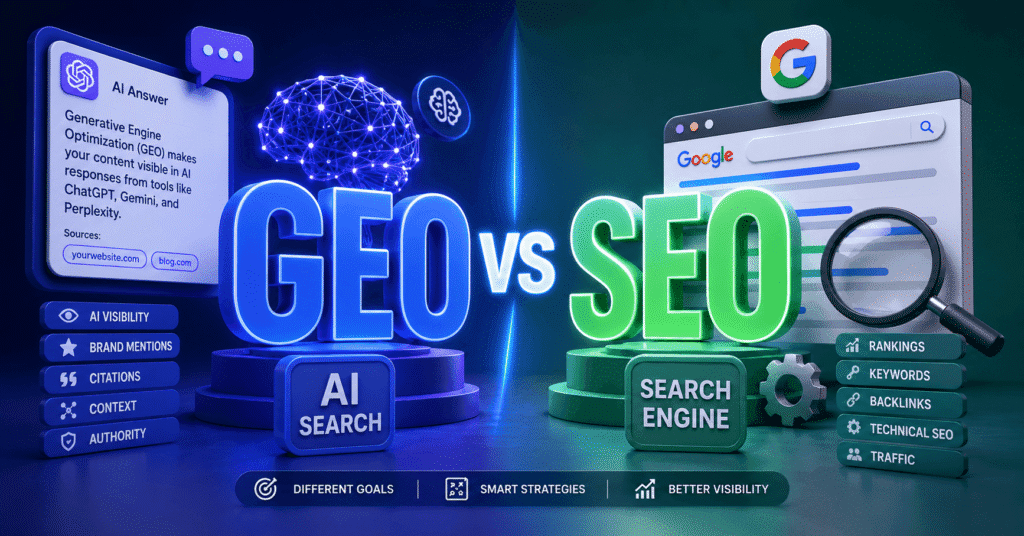
GEO vs SEO – You want to know if GEO is the new SEO or if you need both. In short: SEO optimizes your website for traditional search engines like Google, while GEO (Generative Engine Optimization) prepares content so that AI systems like ChatGPT or Google AI Overviews can use you as a source.
Both approaches aim to increase your visibility, but they operate according to different rules.
While Search Engine Optimization (SEO) relies heavily on keywords, backlinks, and technical factors, Generative Engine Optimization (GEO) primarily evaluates context, structure, and content quality. Studies from the US market show that a large proportion of search queries already contain AI elements—for example, through AI Overviews on Google. The use of AI Search is also increasing significantly in German-speaking countries.
If you want to remain visible online, you need to understand how ranking factors, content optimization, and performance measurement are changing. You’ll learn how search and AI environments differ, which strategies connect them, and which platforms and tools will truly be relevant in 2026.
Table of Contents
GEO vs SEO: Complete Guide to AI Search Optimization in 2026
Fundamentals and definition of terms
GEO and SEO take different approaches to increasing visibility in the digital space. You need to understand how their definitions, platform logic, and objectives differ in order to use both strategies effectively.
Definitions of GEO and SEO
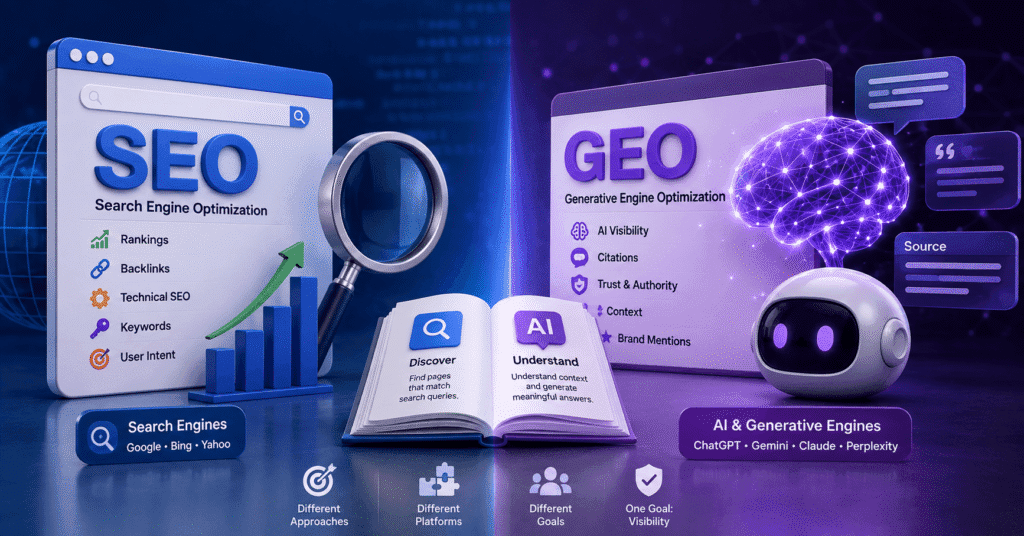
SEO (Search Engine Optimization) refers to all measures you take to optimize content for traditional search engines like Google or Bing. The goal is to appear as high as possible in the organic search results for specific search queries.
You’ll work with keywords, technical optimization, internal linking, and backlinks. Search engines evaluate content using complex algorithms that consider relevance, quality, and user experience.
GEO (Generative Engine Optimization), on the other hand, is aimed at AI-powered systems such as ChatGPT, Gemini, Claude, or Perplexity. These AI engines are based on Large Language Models (LLMs) and deliver direct answers instead of link lists.
With GEO, you optimize content so that it can be cited in answers or used as a source by AI platforms. Initial studies, such as one from Princeton University (2024), show that structured content with clear facts and sources can increase the chance of being mentioned.
Platforms and technologies compared
SEO targets index-based search engines. These systems crawl websites, store content in an index, and match it to search queries. Ranking factors such as loading speed, mobile-friendliness, and backlinks play a central role here.
GEO is aimed at generative AI systems that process content differently. LLMs analyze large amounts of data and generate independent answers. They don’t just rely on a traditional index, but also utilize trained language models and, in some cases, current web data.
One important difference lies in the output:
- Search Engines: List of clickable links
- AI Platforms: Directly formulated answer with possible source references
For you, this means: SEO optimized for rankings, GEO optimized for mentions within an AI response.
Main objectives and how it works
SEO is primarily about gaining organic traffic. The higher your page ranks, the more likely users are to click on your result. In Germany, despite the increasing use of AI, Google remains the most important traffic source.
GEO pursues a different main goal: brand presence in AI responses. When an AI engine quotes your content or mentions your brand, you strengthen your visibility directly in the response text.
The way they work differs significantly:
- SEO: Optimization for ranking algorithms
- GEO: Optimization for semantic understanding of LLMs
- SEO KPIs: Clicks, Impressions, Positions
- GEO KPI: Mentions, citations, visibility in AI responses
You shouldn’t see these two approaches as competing. SEO brings you measurable traffic, while GEO makes your brand visible in new search environments.
Ranking and visibility factors
SEO and GEO follow different logics regarding ranking and search visibility. While SEO relies heavily on measurable signals such as links and technical aspects, GEO primarily considers whether AI systems recognize and cite you as a reliable source.
Ranking signals in SEO
In SEO, clear ranking signals determine your position in the search results. These include, above all, backlinks, technical quality, and relevant content.
Backlinks act like recommendations. The higher the domain authority and credibility of the linking page, the stronger the signal. Studies by Ahrefs and SEMrush regularly show that pages with high-quality links achieve better rankings on average.
Technical SEO also directly impacts your search ranking. This includes clean indexing, fast loading times, mobile optimization, and a clear site structure. Errors in crawlability reduce visibility.
Content-wise, expertise, experience, authority, and trustworthiness play a major role. Google assesses whether your content is factually accurate, up-to-date, and comprehensible. Clear sources, author profiles, and transparent information strengthen your credibility.
Criteria for GEO visibility
GEO is less about traditional rankings and more about mentions and quotes in AI-generated answers. You want to appear in generated responses, not just be in first place.
AI systems analyze vast amounts of text, searching for clear, well-explained information. Structured, precise statements increase the likelihood that your content will be used. Long introductions without a clear message are counterproductive.
Important factors include:
- Frequent brand mentions in the thematic context
- Consistent statements across multiple sources
- Positive evaluation of your brand in public discourse
These signals influence your perceived trustworthiness. Unlike SEO, there are no standardized tools for measuring this yet. You need to actively monitor and document visibility in AI responses.
Entity Recognition and Structuring
Both SEO and GEO benefit from clear entity recognition. Search engines and AI models attempt to uniquely identify entities such as brands, people, or products.
You support this through schema markup and other forms of structured data. This allows you to define, for example, whether it’s a company, an author, or a product. This improves machine learning.
Your content itself should also be clearly structured. Use precise headings, short paragraphs, and unambiguous terms. Repeat key concepts consistently.
This form of entity optimization strengthens your thematic categorization. It increases your chances of stable rankings and simultaneously improves your visibility in generative responses.
Content optimization in search and AI environments
Today, you optimize content for two systems: traditional search engines with ranking logic and AI systems that compile answers directly. Clear structure, clean metadata, and strong trust signals determine whether your content gets clicked or quoted.
Content structure and format
A clear content structure helps Google crawl and AI systems extract information. Use a clean hierarchy with H1, H2, and H3 headings. Each heading should cover its own topic.
Keep paragraphs short and concise. Two to three sentences per paragraph are often sufficient. Long blocks of text make scanning more difficult and reduce the chance of featured snippets or AI quotes.
Use structured content such as lists, tables, and defining paragraphs. Formulate key statements directly and unambiguously. Example:
- “SEO optimizes rankings in search engines.”
- “GEO optimizes content for AI responses.”
Conduct regular content audits. Check for outdated figures, duplicate topics, and weak pages. Update content strategically instead of constantly producing new texts.
Also, pay attention to Core Web Vitals. Fast loading times and stable layouts improve your ranking and generate better user signals.
Metadata, headings and schema
Metadata controls how search engines understand and display your content. Optimize your title tag and meta description to be clear and concise. Use the main keyword and highlight genuine added value.
Headings must be logically structured. Use only one H1 per page. Each additional level should clarify the topic, not repeat it.
Schema markup helps search engines correctly categorize content. Use structured data strategically, for example for:
- FAQ
- How-to instructions
- Reviews
- Organizations or authors
This is particularly important for GEO. AI systems often rely on clearly marked facts, definitions, and FAQ blocks.
If you are working with US tools, check the GDPR context. Tracking and analytics tools must be integrated in a data protection-compliant manner, especially in the DACH region (Germany, Austria, Switzerland).
Quality criteria and trust signals
Google evaluates content based on the EEAT principle: Experience, Expertise, Authoritativeness, Trustworthiness. Demonstrate clear authorship, professional competence, and practical experience.
Add verifiable sources, especially for figures or studies. US sources like Search Engine Land or Ahrefs often provide up-to-date data. Contextualize it and check whether it also applies to the German market.
Use visible trust signals :
- Customer reviews
- References
- Certificates
- Legal notice and clear contact details
Genuine reviews boost both SEO and local visibility. For AI systems, they increase your brand’s credibility.
Don’t just measure rankings. Also pay attention to click-through rate, dwell time, and citation frequency in AI responses. This will help you determine if your content optimization is effective in both environments.
Measuring success and visibility
Today, success is measured not only in rankings, but also in traffic, conversion rate, AI citations, and brand mentions. You need to consider classic SEO KPIs and new AI signals together to understand your true visibility.
Metrics in classic SEO
In traditional SEO, you primarily measure organic traffic, rankings, and click-through rate (CTR) . You obtain this data from Google Search Console and web analytics tools like Google Analytics or Matomo.
Key performance indicators include:
- Impressions and average position
- Click-through rate (CTR) per keyword
- Organic traffic at page level
- Conversion rate from organic traffic
A high ranking is of little use if your click-through rate (CTR) remains low. Therefore, regularly check snippets, title tags, and search intent.
Studies by Ahrefs and SEMrush show that the first three organic results receive the majority of clicks. The click distribution is similar in Germany, even though the market is smaller than in the US.
Ultimately, what matters is not just traffic, but whether that traffic converts. Therefore, measure leads, purchases, and inquiries separately for each channel.
Evaluate AI quotes and brand mentions
At GEO, what matters is whether AI systems like ChatGPT, Google AI Overviews, or Perplexity cite you as a source. Here, you’re not measuring fixed rankings, but rather AI visibility.
Relevant signals include:
- AI Citation : Is your domain linked as a source?
- AI Citations per topic
- Brand mentions in generated responses
- Share of Voice in AI Responses
You can systematically test typical user questions and document whether your brand appears in the results. Some SEO tools offer initial geo-tracking functions, but many analyses are still done manually.
Pay attention to whether the AI only mentions your brand or also includes clickable links. A genuine AI citation with a link is more valuable for traffic and brand building.
Since many systems don’t fully disclose their data sources, you should observe trends over several weeks. Single mentions are not enough to assess success.
Evaluate zero-click and engagement
Zero-click searches are on the rise, especially for informational queries. Users receive answers directly in the search results or AI chat without visiting your website.
This impacts your click-through rate and organic traffic. According to data from Similarweb and SparkToro, the share of zero-click searches in the US was recently well over 50 percent. There are fewer publicly available figures for the DACH region (Germany, Austria, and Switzerland), but the share is also increasing there.
Therefore, in addition to clicks, you should also measure brand visibility and engagement:
- Direct access and brand search queries
- Dwell time and scroll depth
- Conversion rate despite declining click-through rates
If your traffic is decreasing but brand inquiries are increasing, your AI visibility may have grown.
Therefore, do not only evaluate success based on click-through rates or sessions, but also on the entire journey from first contact to conversion.
Strategies for integrating GEO and SEO
If you want to combine GEO and SEO, you need a clear SEO strategy , a complementary GEO strategy , and a stable technical foundation. You optimize content so that it appears in traditional rankings and is simultaneously mentioned or cited in AI responses .
Optimize content for AI and search engines simultaneously
You should plan your content so that it’s understandable for both traditional search engines and AI engines . This starts with a thorough analysis of search intent and user intent .
SEO focuses on rankings, clicks, and conversions. GEO is more about mentions, citations, and visibility in AI-generated responses .
Therefore, pay attention to:
- clear definitions and precise answers to specific questions
- structured paragraphs with subheadings
- FAQ sections for Answer Engine Optimization (AEO)
- consistent terminology and clear brand messages
Studies by Ahrefs and Search Engine Journal (USA, 2024–2025) show that pages with a clear structure and direct answers to questions appear more frequently in AI Overviews. This also applies to the DACH region (Germany, Austria, Switzerland), although the proportion of AI answers still varies depending on the industry.
Your content strategy should therefore utilize topic clusters. A strong pillar page covers the main topic, while supporting pages delve into the details. This way, you simultaneously increase discoverability for both SEO and GEO.
Best practices for technical and content integration
Neither SEO nor GEO works without a stable technical foundation . You need to ensure that your content is indexable and crawlable.
Key points include:
- clean indexing
- high crawlability
- fast charging times
- clear internal linking
- Mobile Friendliness
Google has emphasized the importance of user experience for years. This also applies to AI-powered systems, as many models are based on search indexes.
For content integration, this means:
- Use structured data where it makes sense
- Clearly identify the author (EEAT)
- Make sources transparent
- Update content regularly
Especially in German-speaking countries, trust plays a major role. By making your expertise visible, you increase your chances of appearing as a source in AI-generated answers .
Current challenges and solutions
The biggest challenge with GEO is measurability . While you can clearly see rankings and traffic in traditional SEO, mentions in AI responses are often difficult to track.
Some SEO tools are integrating initial GEO functions. Nevertheless, much remains experimental.
You can use the following approaches:
- Manual prompt tests with typical user questions
- Monitoring of brand mentions
- Analysis of referral traffic from AI systems
- Comparison of visibility before and after content optimizations
Another problem is the dependence on platforms like ChatGPT or Google AI Overviews. You have no direct influence on their models.
Therefore, you should take a broad approach to integrating SEO and GEO . Don’t just focus on rankings, but also on brand building, clear positioning, and high-quality content. This way, you’ll secure visibility in search results and in AI responses simultaneously.
Relevant platforms, tools and trends
Today, you’re no longer optimizing for just one search engine. You’re simultaneously working on traditional search results, AI summaries, and dialogue-based responses. Platform choice, measurability, and tool stack determine how visible your brand remains.
Google, Bing and classic search
Google remains the clear market leader in the DACH region. Bing plays a smaller role, but is gaining importance due to its close ties to Microsoft and Copilot.
With Google AI Overviews, Google blends traditional rankings with AI-generated answers. Your content can appear as a source even if you’re not ranked number one. This shifts the focus from pure rankings to visibility in answers .
In Google Search Console you can still see clicks, impressions, and CTR. A clean separation of AI-generated review traffic is currently only possible to a limited extent.
Therefore, pay attention to:
- stable top 10 rankings
- clear, structured content
- strong EEAT signals
- internal linking and clean technology
Bing also integrates AI elements. If you work internationally, you should include Bing data in your analysis.
ChatGPT, Gemini, Perplexity and AI response engines
ChatGPT, Gemini, Perplexity and Claude use Large Language Models (LLMs). They deliver direct answers instead of lists of links. Users ask questions in natural language and expect clear results.
Perplexity and ChatGPT often display sources. Gemini closely links responses to the Google index. This blurs the lines between SEO and GEO.
Important for you:
- Your brand needs to be mentioned in relevant contexts.
- Content should be precise, fact-based, and citable.
- Repeated mentions on platforms like Reddit or specialist portals increase the likelihood of mentions.
Observe which prompts your brand appears for. Regularly document responses manually or with AI tools.
Data privacy is important, especially with US providers. Check the GDPR compliance of your processes when dealing with sensitive data.
Read Also:- Mistral vs ChatGPT: Which AI Is Better in 2026?
SEO and GEO tools at a glance
For classic SEO, you use established tools such as:
- Google Search Console
- Ahrefs
- SEMrush
These tools display rankings, backlinks, keywords, and sometimes even when Google AI Overviews appear. Studies by Ahrefs and SEMrush show that AI elements can change the click-through rate of organic results, especially for informational search queries.
For GEO, you need additional AI tools. Specialized solutions analyze:
- Mentions and citations in AI responses
- Share of Voice in LLMs
- Prompt performance
- AI referral traffic
Many of these tools are still new. The data is less stable than in traditional SEO.
Therefore, you should combine both worlds: solid SEO data as a basis and complementary GEO analyses for AI visibility.

Lokesh Sharma is a digital marketer and SEO expert at TechJustify with a keen interest in emerging technology trends including AI, cybersecurity, and digital marketing tools for more than 5 years. He writes clear, actionable articles for tech enthusiasts and business leaders, simplifying complex topics like VPNs, automation, and generative AI.