

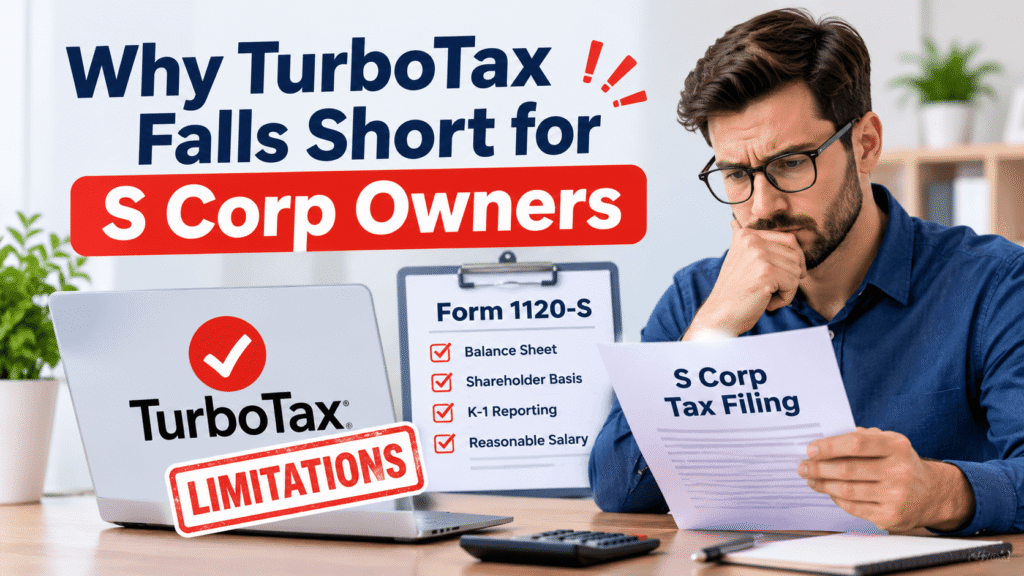
Consumer tax software works well for many people. If you have a W-2 job and a fairly simple return, programs like TurboTax can get the job done quickly. But once you own an S corp, your tax situation changes in ways that consumer software is not always designed to handle well.
If you are weighing whether to keep doing your own taxes, here is why many S corp owners look for a turbotax alternative.
Table of Contents
Why TurboTax Falls Short for S CorpOwners
What Form 1120-S Requires That Consumer Software Skips
As an S corp owner, you file two returns each year. The first is Form 1120-S, the business return, which reports the company’s income, deductions, and profit. The second is your personal Form 1040, which includes your share of the business income through a Schedule K-1.
Form 1120-S requires more than simply entering totals. You need a complete balance sheet, reconciliations between your books and your tax return, accurate tracking of shareholder distributions, and correct reporting of officer compensation. You also need to track your shareholder basis, which determines how much you can deduct in losses and whether your distributions are taxable.
Many consumer products either do not support the 1120-S at all or require a separate business edition. Even when the software can produce the form, it relies on you to know what belongs where. It will not tell you whether your salary is reasonable, whether a distribution exceeded your basis, or whether your books are ready to support the return. Professional s corp tax filing brings an expert review to the details that software leaves to you.
Getting Your Personal and Business Returns to Match
One of the most common problems for S corp owners is a mismatch between the business return and the personal return. Your K-1, your W-2 wages from the S corp, and certain benefits like health insurance premiums all need to line up correctly across both filings.
For example, health insurance premiums for owners who hold more than two percent of the company are typically included in W-2 wages and then deducted on the personal return. If those amounts are not handled consistently, you could lose a valuable deduction or trigger a notice from the IRS.
Timing adds another challenge. The S corp return is generally due March 15, a month before the personal deadline, and your personal return depends on the numbers from the business return. Errors on the 1120-S flow directly into your 1040.
Having one team prepare both returns, with access to your bookkeeping and payroll records, makes it much easier to keep everything consistent. It also gives you a single point of contact if the IRS or your state ever has questions about either filing.
Read Also:- Top 5 Payroll Software For Small Businesses in 2027
Final Thoughts
TurboTax is a useful tool, but S corp ownership brings complexity that goes beyond what most consumer software is built to handle. Accurate books, basis tracking, and matching returns all require careful attention. With support from Collective, you can file with confidence and focus on running your business instead of deciphering tax forms.

Lokesh Sharma is a digital marketer and SEO expert at TechJustify with a keen interest in emerging technology trends including AI, cybersecurity, and digital marketing tools for more than 5 years. He writes clear, actionable articles for tech enthusiasts and business leaders, simplifying complex topics like VPNs, automation, and generative AI.