

Looking for an AI agent to boost your company’s productivity? Discover our 2026 comparison of the 10 best solutions, with their advantages and our recommendations based on your needs.
By 2026, artificial intelligence agents will have become indispensable in the daily operations of businesses. Where automation was once limited to repetitive tasks, modern AI agents are now capable of making decisions, interacting in natural language, and integrating with business tools to deliver truly operational work.
Their added value is clear: time savings , cost reductions , and increased productivity. Whether it’s qualifying leads, automating customer support, generating reports, or streamlining internal collaboration, AI agents allow teams to focus on higher-value tasks.
In this article, we’ve selected the 10 best AI agents for 2026 , with a comprehensive comparison of their strengths and limitations. Our goal: to help you identify the tool best suited to your needs, whether you’re an SME seeking simplicity or a large corporation looking to industrialize your AI applications.
Table of Contents
What is an AI agent?
An AI agent is an autonomous software program that uses artificial intelligence to understand a request, make decisions, and execute actions without direct human intervention. Unlike a traditional chatbot , which is often limited to predefined scripts and fixed scenarios, an AI agent can adapt to the context, learn new situations, and handle more complex tasks.
Compared to a traditional automation tool (like Zapier or Make), an AI agent goes beyond simply following rules: it can reason, interact in natural language, and intelligently orchestrate multiple steps.
There are generally three main categories of AI agents :
- Technical frameworks (code) → intended for developers, they allow the construction of customized agents by integrating AI models, APIs and complex workflows.
- No-code / low-code tools → designed for non-technical teams, they offer a simple visual interface to quickly create functional AI agents.
- Business platforms → specialized in a specific area (customer support, sales, marketing…), they offer ready-to-use agents, already connected to the tools used daily.
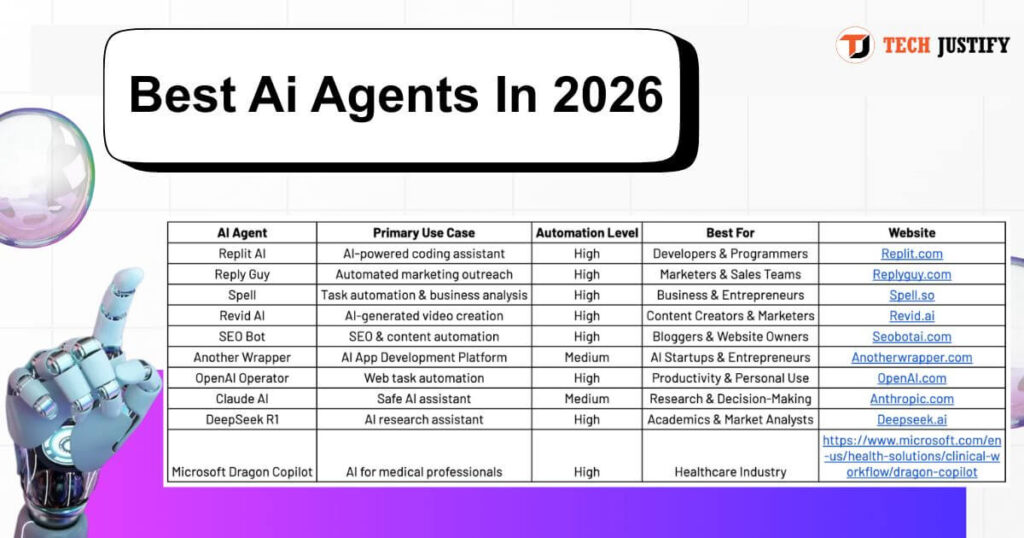
Ranking of the best AI agents in 2026
Each of these categories addresses different needs. Here is our selection of the best-performing solutions in 2026, along with their strengths and use cases.
A. Technical frameworks (for developers)
These solutions are aimed at technical and data teams who want to maintain complete control over the design and deployment of AI agents. They require some development experience but offer unparalleled power and customization.
#1 Botpress
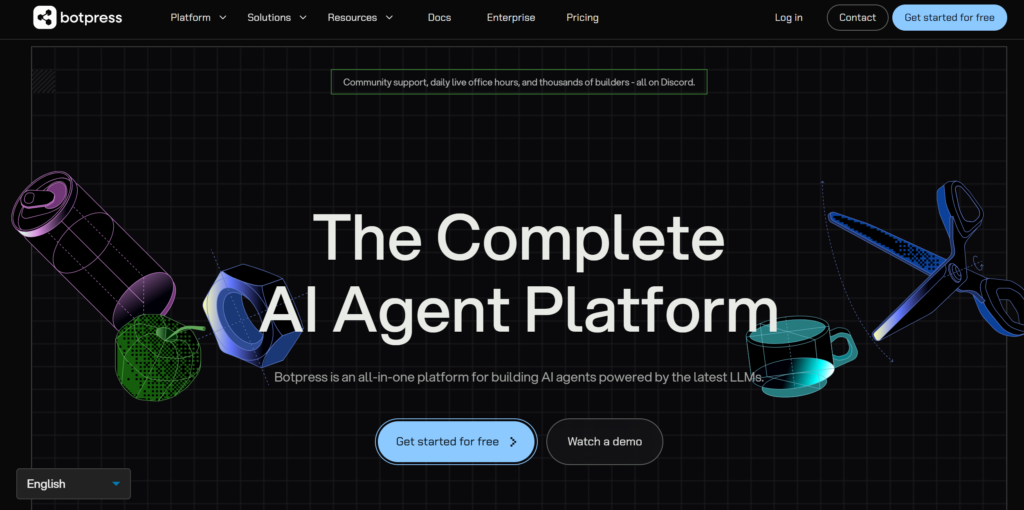
Botpress is an open-source frameworkdesigned for building advanced artificial intelligence agents. Unlike ready-made business platforms, Botpress is geared more towards technical teams who want complete control over their AI agents while benefiting from an intuitive visual environment.
With Agent Studio , its graphical editor, it’s possible to design agents using drag-and-drop, centralize knowledge sources, configure language models, and connect any API.
Its main strength lies in its balance between no-code and technical flexibility . Users can build conversations visually, while also having the option to add custom code to handle complex scenarios.
For example, a team can use Botpress to create a multichannel agent capable of responding to customers on the website, Slack, and WhatsApp, while connecting directly to the company’s CRM to retrieve and update information in real time.
Advantages:
✅ Open-source, customizable, and self-hostable.
✅ Intuitive visual editor (drag-and-drop).
✅ Integration of multiple knowledge bases (files, websites, history).
✅ Multi-channel support (web, chat, messaging).
✅ Ability to add code and connect APIs.
Disadvantages:
❌ Primarily intended for developers and technical teams.
❌ More complex to implement than a turnkey business platform.
❌ Requires time to configure and optimize agents.
Who is Botpress for?
Botpress is ideal for technical teams, tech startups and innovative companies that want to create powerful, custom and multi-channel AI agents, while maintaining total control over architecture and personalization.
👉 Discover Botpress: botpress.com
#2 LangChain
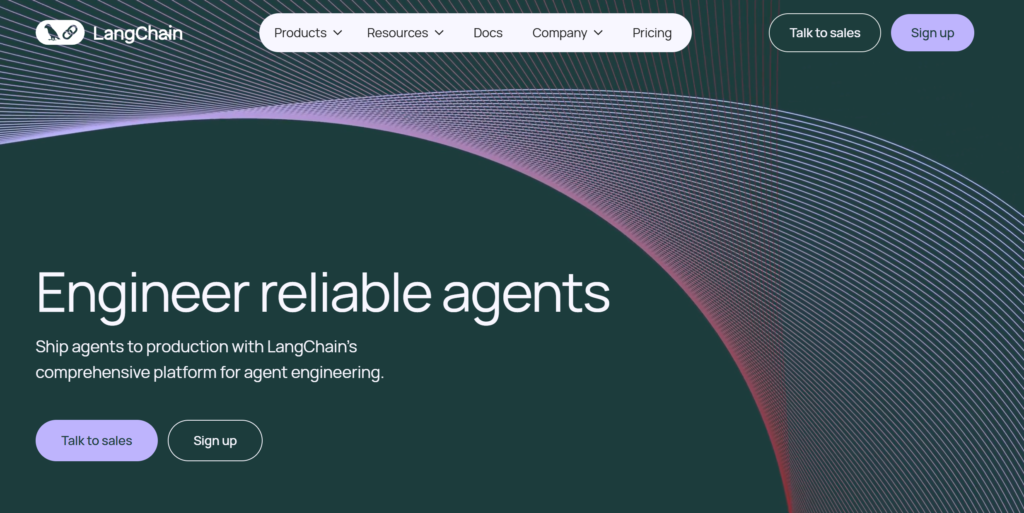
LangChain is one of the most popular frameworks for building AI agents. Designed for developers and technical teams, it offers a modular architecture that simplifies the design, orchestration, and deployment of reliable agents capable of handling complex tasks.
Its greatest strength lies in its ability to combine different components (LLMs, databases, APIs) through a library of overready-to-use integrations .
One of LangChain’s key use cases is the implementation of Retrieval-Augmented Generation (RAG) systems : the agent can query a knowledge base, retrieve relevant documents, and generate an enriched, accurate, and contextualized response.
For example, a company could use it to build a support assistant that consults its internal documentation in real time and provides customers with precise answers.
LangChain is not limited to orchestration: with its tools like LangSmith (observability, performance evaluation) and LangGraph (advanced orchestration, memory, multi-agent workflows), it provides a complete stack to go from design to production deployment.
Advantages:
✅ Modular, flexible, and open-source framework.
✅ Native RAG management for contextualized responses.
✅ Huge integration ecosystem (600+ connectors).
✅ Built-in tools for orchestration, monitoring, and debugging.
✅ Supported by a massive community (1M+ developers, 100k+ GitHub stars).
Disadvantages:
❌ Designed for developers, requires technical skills.
❌ Longer learning curve than no-code solutions.
❌ Requires infrastructure for scaling.
Who is LangChain for?
LangChain is ideal for technical teams, data engineers and AI startups who want to develop robust, reliable and customized agents, with the ability to handle complex flows (RAG, multi-agent, advanced orchestration).
👉 Discover LangChain: langchain.com
#3 AutoGen (Microsoft)
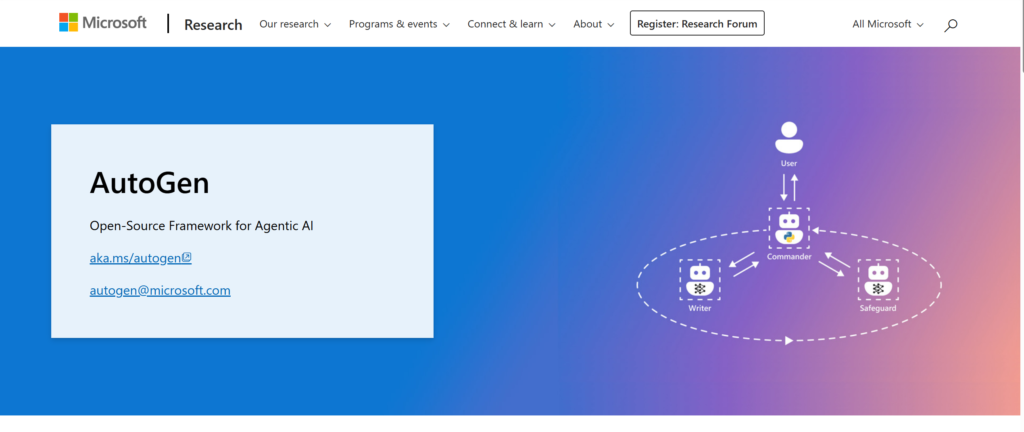
AutoGen is an open-source framework developed by Microsoft Research for orchestrating and collaborating artificial intelligence agents. Unlike frameworks focused on a single agent (such as Botpress), AutoGen is designed to coordinate multiple AI agents working together—or interacting with humans—to solve complex tasks.
The latest version ( AutoGen v0.4 ) introduces an asynchronous and event-driven architecture , enabling the management of large-scale multi-agent scenarios with improved observability and integrated debugging tools.
Developers can define complementary roles (e.g., a “Commander” agent that oversees, a “Writer” agent that produces content, and a “Safeguard” agent that monitors quality or compliance), making seamless AI-AI or AI-human collaboration possible.
AutoGen also stands out for its modularity : it’s possible to connect different language models, tools, memory, and APIs, and even to have agents coded in different languages (Python, .NET, and soon others) collaborate. This makes it a robust platform for R&D projects, but also for companies that want to build distributed and reliable agent workflows.
Advantages:
✅ Orchestration of multi-agent teams (AI ↔ AI or AI ↔ human).
✅ Event-driven and asynchronous architecture for scalability.
✅ Integrated tools for observability, monitoring, and debugging.
✅ Modularity and extensibility (addition of agents, tools, and custom models).
✅ Multi-language support (Python, .NET, etc.).
Disadvantages:
❌ Heavily geared towards developers and researchers, not well-suited for non-technical users.
❌ More complex learning curve than no-code/low-code tools.
❌ Still in its early stages: some advanced features are under development.
Who is AutoGen for?
AutoGen is particularly suited to R&D teams, AI startups, and technology companies looking to design orchestrated multi-agent systems (collaboration, supervision, complex tasks), with a high degree of personalization and control.
👉 Discover AutoGen: microsoft.com
B. No-code / low-code tools (accessible without technical skills)
Designed for SMEs, startups, and business teams , these tools allow you to create AI agents and automations without writing a single line of code. Their strength: a visual interface and ready-to-use connectors.
#4 n8n
n8n is an open-source automation platform that sits between technical frameworks (like LangChain) and no-code tools. It allows you to build production-ready AI agents by combining AI, deterministic logic, and business connectors (more than 500 native integrations ).
With its visual drag-and-drop editor , n8n makes agent creation accessible to non-technical users, while still allowing developers to add code or customize workflows.
Its strength lies in the ability to combine automation and AI : clear rules (conditions, human validation, fallback in case of errors) can be defined to ensure reliable and predictable agents.
There are many use cases:
- Multi -agent systems : coordinating several specialized agents (e.g., research, writing, validation) .
- RAG agents : integrate internal or external data to produce verified and up-to-date responses.
- Research & planning agents : breaking down a complex problem into automatically orchestrated subtasks .
- Business automation : connecting AI to everyday tools (Slack, Google Drive, HubSpot, Salesforce…
benefits :
✅ Open-source, self-hostable, and SOC 2 compliant.
✅ 500+ native integrations (CRM, cloud, databases, APIs).
✅ Simple visual editor with the ability to add code.
✅ Deterministic logic and safeguards (human-in-the-loop, validations).
✅ Large community (90k+ GitHub stars, thousands of templates).
Disadvantages :
❌ More complex to configure than 100% no-code solutions (e.g., Relay.app).
❌ May require technical support for production deployment.
❌ Less specialized in AI conversations than tools like Voiceflow
Who is n8n for?
n8n is particularly suited to innovative technical, ops and SME teams looking to automate their business workflows by combining AI and classic automation, with the flexibility of open-source and without dependence on a single vendor.
👉 Discover n8n: n8n.io/ai-agents
#5 Make.com
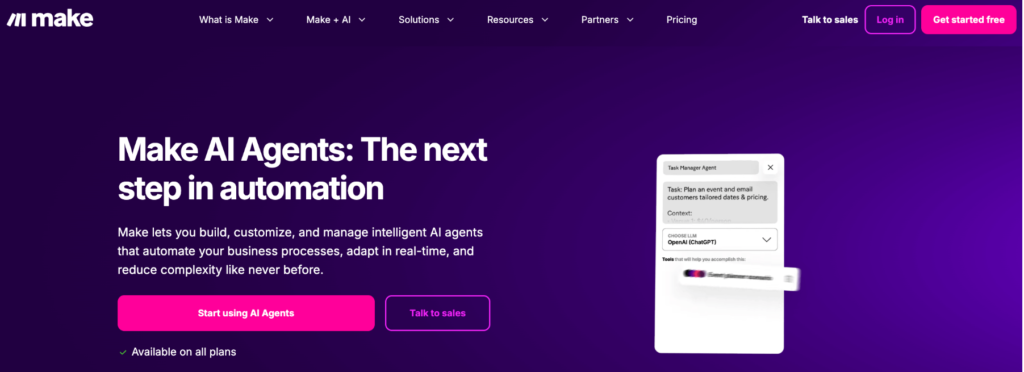
Make is a visual automation platform that allows you to create AI Agents capable of orchestrating complex workflows without writing a single line of code. Unlike the rigid rules of traditional systems, Make’s AI agents are adaptive : they understand objectives defined in natural language and adjust actions in real time based on context.
With over 2,500 integrated applications and 30,000 available actions , Make stands out thanks to its vast library of connectors. This allows businesses to automate scenarios ranging from customer support and marketing to finance and operations, while directly integrating AI models (OpenAI and other compatible ones).
A typical use case would be a marketing team using Make to automatically generate content from ideas in Google Sheets, publish on social media, analyze performance, and trigger real-time adjustments based on results.
Advantages:
✅ Simple and intuitive visual platform, accessible without technical skills.
✅ 2,500+ native integrations and 30,000+ ready-to-use actions.
✅ Adaptive AI agents: adjust workflows in real time.
✅ Centralized management: reuse agents across multiple scenarios.
✅ Compatible with various LLMs (including OpenAI).
Disadvantages:
❌ Less flexible than technical frameworks like LangChain.
❌ Can become expensive at scale (high execution volume).
❌ Dependence on the cloud platform (limited on-premises options).
Who is Make.com for?
Make is ideal for SMEs, startups, and business teams that want to leverage the power of AI and automation without development. It’s a particularly effective solution for marketing, sales, and customer experience , thanks to its visual approach and extensive integrations.
👉 Discover Make AI Agents: make.com/en/ai-agents
#6 Relay.app
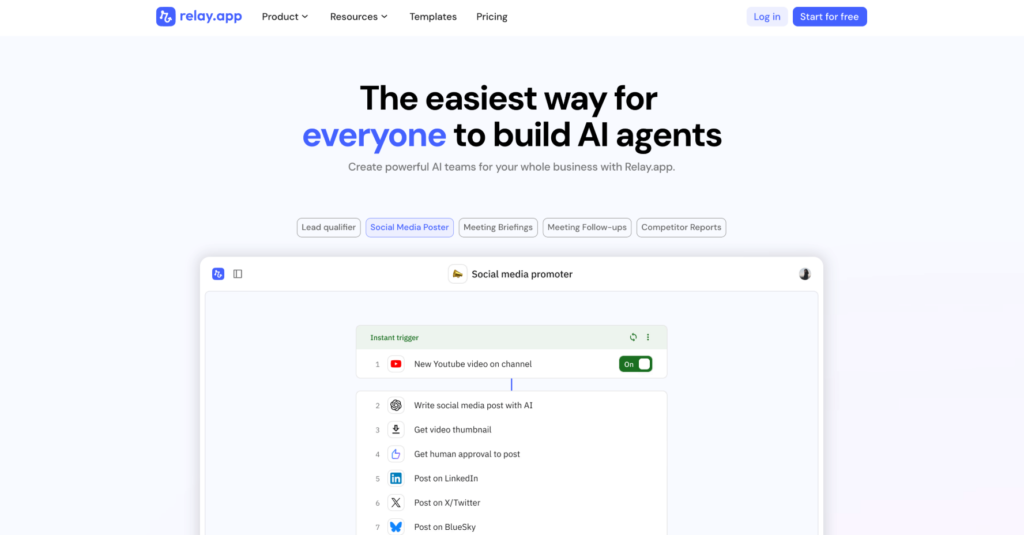
Relay.app is a no-code solution designed to make creating AI agents accessible to all teams, even without technical skills. Its promise: to allow everyone to coordinate AI agents with their existing business tools (Google Sheets, Notion, Salesforce, Slack, HubSpot, etc.) to automate tasks end-to-end.
The platform offers a wide catalog of ready-to-use templates (meeting briefings, post-meeting follow-ups, lead qualification, competitor reports, LinkedIn post writing, etc.) that can be customized in just a few clicks. Its unique feature is the integration of human checkpoints (approvals, tasks, data entry) to maintain control over sensitive steps: a real advantage for companies that want to combine efficiency and security .
Relay.app also shines thanks to its intuitive interface and 100+ deep integrations , designed to respect business processes without requiring teams to adapt to the tool. This makes it an attractive alternative to Zapier or Make, but with a simplified and more AI-driven experience.
Advantages:
✅ Simple and quick-to-learn no-code platform.
✅ Ready-to-use AI agent templates (sales, marketing, support, reporting).
✅ Native integrations with the most widely used business tools.
✅ Option to involve a human in the process (approvals, tasks).
✅ Ideal for creating customized and reliable workflows without writing code.
Disadvantages:
❌ Less flexible than technical frameworks (e.g., LangChain, n8n).
❌ Newer community and more limited integration catalog than Make.
❌ More focused on productivity and automation than on highly complex use cases.
Who is Relay.app for?
Relay.app is ideal for SMEs, startups, and business teams (sales, marketing, operations) that want to quickly automate processes while retaining the ability to validate critical actions. It’s an excellent choice for those who find Zapier or Make too cumbersome or technical, but still want to leverage reliable AI agents.
👉 Discover Relay.app: relay.app
#7 Manus.im
Manus.im positions itself as a platform of general-purpose AI agents , capable of linking thought and action to autonomously execute complex tasks. Unlike traditional automation tools, Manus doesn’t simply execute predefined rules: its agents are designed to reason, plan, and produce value-added content or deliverables.
One of Manus.im’s key uses is the intelligent generation of documents and reports . Companies can entrust an AI agent with the writing of analyses, summaries, strategic notes, or operational reports, drawing on their own data and business contexts. The tool goes beyond a simple “writing copilot” by integrating reflection and structuring steps, making it suitable for professional deliverables.
The platform aims to offer a versatile AI agent , capable of integrating into different work environments (support, research, internal productivity) while maintaining a high level of personalization.
Advantages:
✅ Generalist AI agents capable of linking “thought” (analysis, reasoning) and “action” (production, automation).
✅ Specialization in generating intelligent documents, summaries, and reports.
✅ Saves considerable time on writing and structuring information.
✅ Ambitious vision: agents capable of covering multiple business functions.
Disadvantages:
❌ Still a young tool, with limited community and integrations.
❌ Less focused on workflow automation than n8n or Make.
❌ May require precise scoping to obtain reliable and compliant deliverables.
Who is Manus.im for?
Manus.im is designed for teams that regularly produce documents or analyses (consulting, research, finance, strategy, operational reporting). It is also for companies that want to test a more “generalist” approach to AI agents, capable of going beyond simple automation to generate high-quality deliverables.
👉 Discover Manus.im: manus.im
C. Business platforms (support, sales and marketing)
These tools are specialized by function and offer AI agents pre-integrated into a business environment (CRM, support, marketing). Their advantage: rapid deployment and easy adoption by teams.
#8 Zendesk AI Agents
Zendesk AI Agents automate over 80% of customer interactions using agentic AI . Unlike traditional chatbots that follow predefined scripts, these agents can reason, adapt to context, and act autonomously across all channels (chat, email, social messaging, help center). The result: faster support, reduced costs, and an improved customer experience.
Their major advantage lies in their native integration with the Zendesk ecosystem . In just a few days, a company can deploy AI agents capable of handling frequently asked questions, qualifying tickets, automating routing, and even managing complex end-to-end processes through backend integrations.
Client companies report concrete gains: a 35% to 50% reduction in ticket volume, improved CSAT (+9% in some cases) and substantial savings (up to $434,000 saved per year ).
Advantages:
✅ Rapid deployment (in days, not months).
✅ Automation rates up to 80% and higher.
✅ Native integration with Zendesk (tickets, knowledge bases, analytics).
✅ Intelligent safeguards and real-time observability.
✅ Multichannel and multilingual.
Disadvantages:
❌ Heavily tied to the Zendesk ecosystem (less useful for non-Zendesk customers).
❌ Requires a well-structured knowledge base for optimal results.
❌ Less flexible than a technical framework or a specialized no-code platform.
Who is Zendesk AI Agents for?
Companies of all sizes that are already Zendesk customers (e-commerce, SaaS, retail, services) who want to improve their customer support at scale while reducing their operational costs.
👉 Discover Zendesk AI Agents: zendesk.com/service/ai/ai-agents
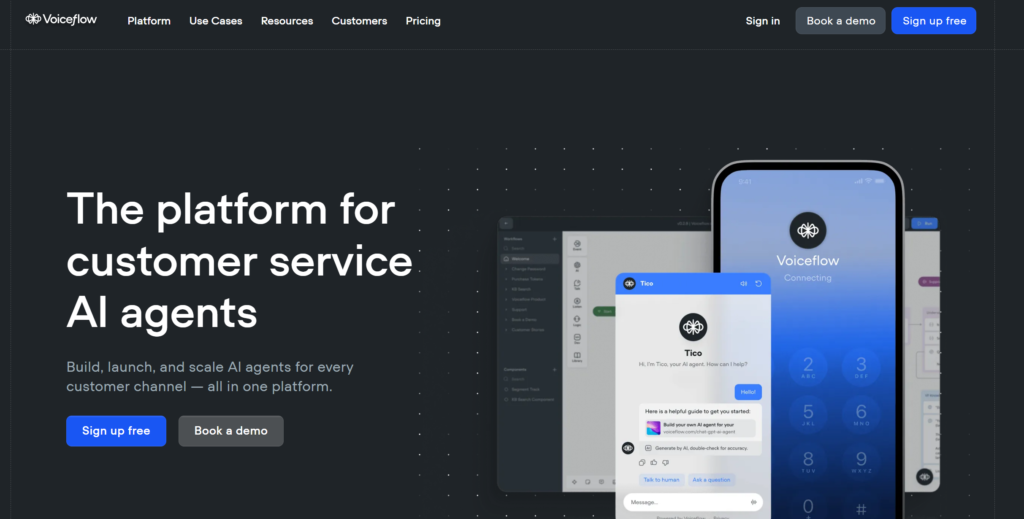
#9 Voiceflow
Voiceflow is a comprehensive platform for creating AI conversational agents (chat and voice), designed for product, support, and marketing teams. It allows you to design, deploy, and manage agents capable of naturally interacting with customers, without requiring any coding skills.
Thanks to its intuitive visual editor, Voiceflow allows you to build complex conversational flows using drag and drop, while also offering the ability to add code, APIs, and advanced integrations for the most sophisticated use cases. The tool stands out for its ability to adapt to both chat interactions and automated phone calls .
As a concrete example, Trilogy was able to automate 70% of its first-level support tickets , generating savings of $425,000 in 90 days thanks to an agent designed with Voiceflow.
Advantages:
✅ Support for chat and voice agents on a single platform.
✅ Simple, extensible visual interface with APIs and custom features.
✅ Proven use cases: massive automation of customer support.
✅ Rich ecosystem: native integrations, community of 500,000+ users.
✅ Enterprise compliance (SOC-2, GDPR).
Disadvantages:
❌ Focused on conversational interfaces (less suited to other automations).
❌ May require a significant design phase for complex cases.
❌ Less accessible to very small organizations without a significant volume of interactions.
Who is Voiceflow for? Product, support and marketing teams
who want to design advanced conversational experiences (chatbots and voicebots) to automate their responses, reduce team workload and improve customer satisfaction.
👉 Discover Voiceflow: voiceflow.com
#10 HubSpot AI
HubSpot AI (via Breeze Agents ) adds a new dimension to HubSpot’s CRM and Marketing Hub. The goal is to build a virtual team of AI agents capable of automating high-value tasks in marketing, sales, and customer support. With Breeze Studio , companies can discover, customize, and deploy ready-to-use AI agents or create bespoke assistants trained on their own knowledge base and CRM data. The agents cover a wide range of tasks: marketing content generation, lead scoring and qualification, sales closing support, proactive knowledge base management, and hyper-personalization of customer journeys.
Examples of Breeze agents:
- Customer Agent → responds to recurring requests and escalates complex cases.
- Prospecting Agent → automatically identifies and engages the most promising leads.
- Closing Agent → supports sales teams in monitoring and accelerating deals.
- Knowledge Base Agent → writes and updates help articles based on tickets.
- Personalization Agent → creates personalized content and CTAs based on segments.
Advantages:
✅ Natively integrated with HubSpot CRM and Marketing Hub.
✅ Large catalog of ready-made AI agents (Breeze Marketplace).
✅ Ability to create and customize your own agents.
✅ Performance tracking with integrated analytics.
✅ Suitable for both SMEs and large enterprises.
Disadvantages :
❌ Limited to the HubSpot ecosystem (difficult to use outside of it).
❌ Some advanced features still in beta (closing, prospecting).
❌ May require a gradual learning curve to be fully utilized.
Who is HubSpot AI for?
B2B and B2C companies that already use HubSpot CRM and want to boost their teams with built-in AI agents capable of generating content, qualifying leads and accelerating sales while reducing manual workload.

Pradeep Sharma is a author the mind behind Techjustify, where I craft insightful blogs on technology, digital tools, gaming, AI, and beyond. With years of experience in digital marketing and a passion for tech innovation, I aim to simplify complex topics for readers worldwide.
My mission is to empower individuals with practical knowledge and up-to-date insights, helping them make informed decisions in the ever-evolving digital landscape.