

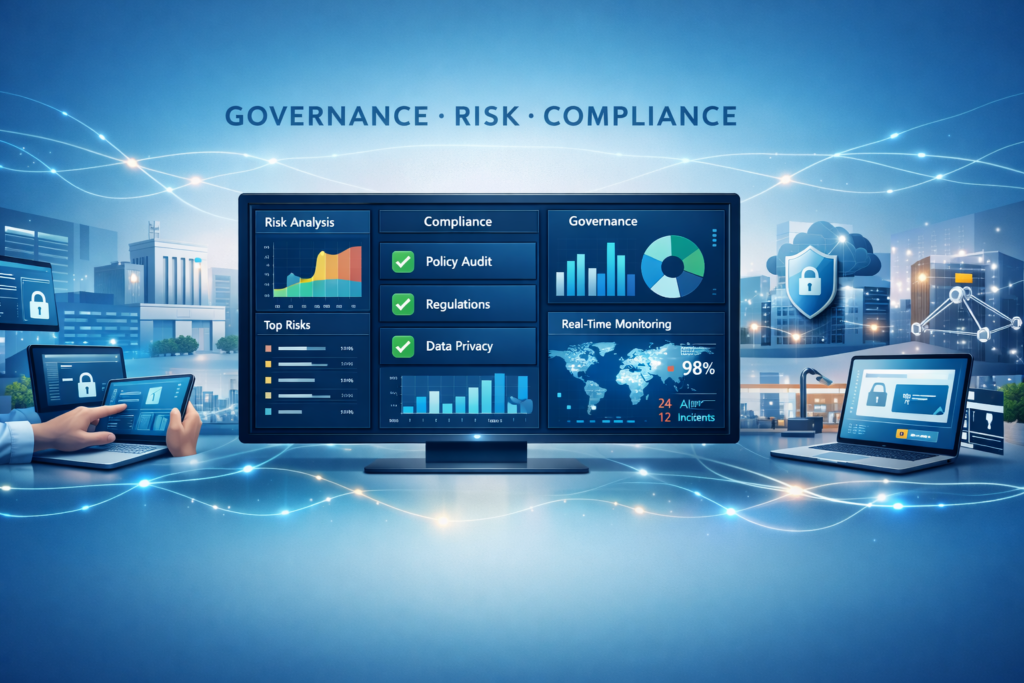
Governance, risk, and compliance (GRC) can sometimes feel abstract, defined by frameworks, policies, and regulatory language rather than day-to-day business realities. In practice, however, effective GRC strategies have a direct and measurable impact on how organizations operate, respond to threats, and grow with confidence. Real-world examples across industries show how GRC moves from theory into action.
Table of Contents
5 Real World Examples of GRC Strategies in Action
Financial Services: Strengthening Trust and Stability
In the financial sector, GRC strategies are deeply embedded in core operations. Banks and fintech firms face constant regulatory scrutiny, along with high exposure to fraud and cyber risk. Leading institutions integrate risk assessments into product development, ensuring new services meet regulatory and security requirements before launch.
For example, many financial organizations use continuous monitoring to track transaction anomalies and real-time compliance metrics. This allows teams to detect potential issues early, respond quickly, and demonstrate accountability to regulators. Strong governance structures also help boards maintain oversight of risk appetite and compliance posture, reinforcing trust with customers and investors.
Healthcare: Protecting Data and Ensuring Continuity
Healthcare organizations operate in an environment where compliance and risk management are closely tied to patient safety. Regulations governing patient data, clinical systems, and service availability require strict controls.
Hospitals and health networks often implement centralized GRC programs to align IT security, privacy requirements, and operational resilience. By mapping regulatory obligations directly to internal controls, they reduce the risk of data breaches and service disruptions. When incidents do occur, clear governance frameworks ensure faster decision-making and coordinated responses across clinical, technical, and administrative teams.
Technology and SaaS: Scaling Without Losing Control
Fast-growing technology companies face a different challenge: scaling rapidly while maintaining governance and compliance. Startups and SaaS providers often serve global customers early in their lifecycle, exposing them to multiple regulatory regimes.
Successful tech firms embed GRC into their growth strategy. Automated policy management, access controls, and audit-ready reporting allow them to meet customer and partner expectations without slowing innovation. These practices also support enterprise sales, where strong compliance and risk management are often prerequisites for contracts.
In this context, structured Governance, Risk and Compliance (GRC) Management enables technology companies to balance agility with accountability, ensuring growth does not introduce unmanaged risk.
Manufacturing and Supply Chains: Managing Operational Risk
Manufacturing organizations rely on complex supply chains that span regions and suppliers. Disruptions, from geopolitical events to supplier failures, can have serious operational and financial consequences.
GRC strategies in this sector often focus on third-party risk management and operational resilience. Companies assess suppliers’ compliance, security, and continuity capabilities and integrate this information into enterprise risk dashboards. This visibility enables leaders to identify vulnerabilities, diversify the supplier base, and respond more effectively to disruptions.
Clear governance also ensures that sustainability and safety requirements are enforced consistently across the supply chain, aligning operations with regulatory and ethical expectations.
Retail and E-Commerce: Navigating Consumer and Data Regulations
Retailers and e-commerce platforms manage high volumes of consumer data and payment transactions, making compliance and risk management critical. Regulations around data protection, consumer rights, and payment security require coordinated oversight across marketing, IT, and operations.
Retail organizations with mature GRC programs centralize compliance tracking and incident response. This reduces the risk of regulatory penalties and improves customer trust, especially in highly competitive digital markets where reputation can change quickly.
Turning Strategy Into Everyday Practice
Across industries, the most effective GRC strategies share common traits: integration, automation, and leadership visibility. Governance provides clear accountability, risk management anticipates threats before they escalate, and compliance becomes a continuous process rather than a periodic task.
These real-world examples show that GRC is not just about meeting regulatory requirements. When applied thoughtfully, it becomes a strategic capability that strengthens resilience, supports innovation, and enables organizations to operate with confidence in complex and fast-changing environments.

Pradeep Sharma is a author the mind behind Techjustify, where I craft insightful blogs on technology, digital tools, gaming, AI, and beyond. With years of experience in digital marketing and a passion for tech innovation, I aim to simplify complex topics for readers worldwide.
My mission is to empower individuals with practical knowledge and up-to-date insights, helping them make informed decisions in the ever-evolving digital landscape.