

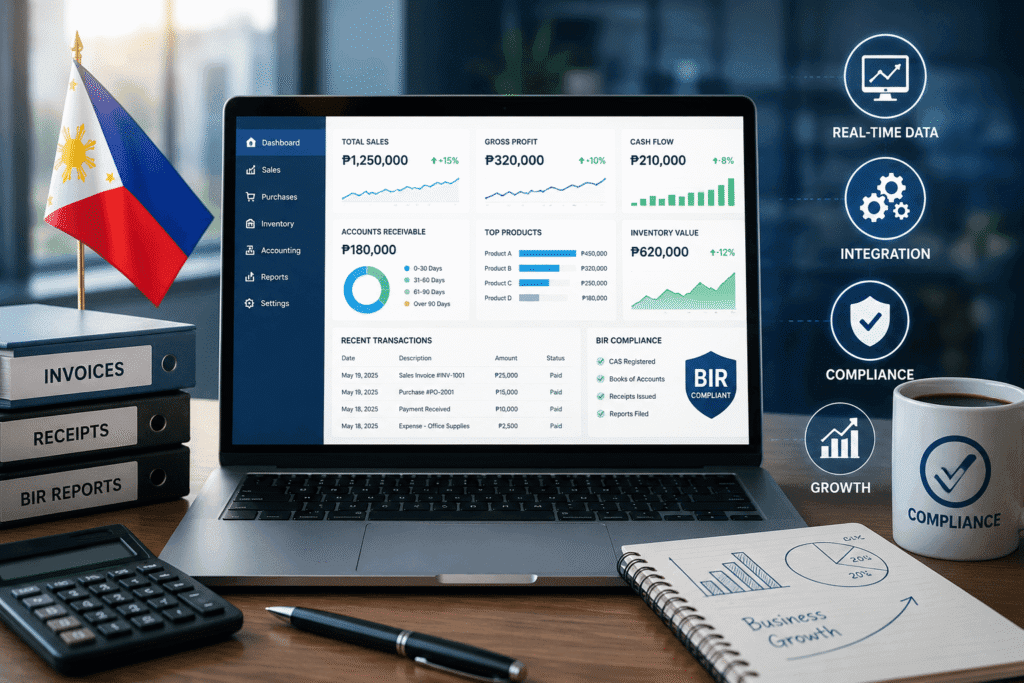
CAS – Running a business in the Philippines is complex, especially when you’re juggling growth, compliance, and daily operations. You want your numbers to make sense, your team to work smoothly, and your business to stay on the right side of government rules. In this context, whether you’re expanding, digitizing, or cleaning up your accounting processes, the question eventually arises: “Is it time to use a computerized accounting system (CAS)?
Looking closely at the details, it becomes clear that the answer is almost always yes. To understand why, it helps to consider how this tool affects both compliance and business efficiency.
Table of Contents
What Is a CAS and Why Your Business Needs One ASAP
What a CAS Does for Your Business
If you’ve ever managed spreadsheets, separate sales apps, and standalone accounting software, you know how frustrating it can be. Numbers often don’t match, reports take longer to prepare, and your team spends too much time re-entering data instead of focusing on tasks that drive growth.
A CAS solves these problems by connecting every part of your business into one ecosystem. For example, your sales team enters an invoice. With a CAS, your inventory updates the stock change, your general ledger captures the sale immediately, and your accounts receivable reflects the amount due. The software does everything automatically without the need for manual input.
What’s even better is that there are now scalable CAS platforms designed for all types of businesses, offering most of the benefits of enterprise systems without the complexity or cost.
Why Integration Makes a Big Difference
Integration is one of the most powerful aspects of a modern CAS. Specifically, when your accounting module communicates with all other business functions, you reduce manual entry, eliminate errors, and ensure consistent data across departments.
Having a single source of truth also makes your team more efficient. For instance, since they work from the same accurate data, they can reconcile numbers fast. This means you’ll spend less time chasing mismatched figures and more time analyzing performance.
Why CAS Matters When Compliance Is Key
The Bureau of Internal Revenue (BIR) has specific requirements related to CAS. For example, you must register your CAS with the BIR. Revenue Memorandum Order (RMO) No. 21-2000 and RMO No. 29-2002 lay out the policies and guidelines of the compliance process and ensure your BIR accredited accounting system works as intended.
It’s important that you follow the application and approval procedures because failure to comply with these specific regulations can lead to steep penalties. For example, your business could incur surcharges ranging from 25% to 50% on the tax due for non-filing or filing fraudulent returns. This could be on top of a mandatory interest penalty of 12% per annum on any unpaid tax calculated from the due date. Beyond these quantifiable monetary penalties, the BIR also imposes fines for specific administrative violations like failing to register the business, not issuing required receipts, or neglecting to maintain proper books of accounts.
Crucially, the non-compliance process leads to severe business disruption. A formal tax audit consumes immense time and company resources, diverting staff from their core functions. The most severe cases of violation can even lead to the closure of the business.
How CAS Protects You from Penalties and Mistakes
You might think compliance is just about avoiding penalties, but it’s more than that. For instance, since a registered CAS ensures your books meet BIR standards, they make audits simpler and more predictable. While traditional methods still work, they make tracing transactions more time-consuming. In contrast, a CAS keeps an audit trail of every sale, adjustment, approval, or cancellation, along with who made the change and when. That transparency makes audits far less intimidating because the BIR can easily trace each transaction back to its original document.
Moreover, most penalties arise from human error rather than intentional violations. By keeping all your data centralized, a CAS minimizes mistakes like missing receipts, unrecorded sales, or incorrect journal entries. Your records stay organized, and your team can focus on running the business rather than scrambling to fix errors. This prevents unnecessary stress and gives you confidence that your filings reflect the real situation in your business. You also show regulators, investors, and even your suppliers that your financial data is trustworthy.
How CAS Helps You Make Smarter Decisions
Access to real-time, accurate data can change how you manage your business. With a CAS, you can see your cash flow, inventory levels, outstanding invoices, and overall financial performance in a single view as the information comes in. This allows you to act before small issues become bigger problems.
For instance, if you rely on manual spreadsheets to track inventory, you might accidentally oversell a popular item. Meanwhile, a CAS can update inventory automatically, giving you a precise picture of stock availability and helping you plan orders efficiently. Some systems even let you set alerts for low inventory or overdue invoices, which prevents these issues from happening and affecting your operations.
Furthermore, integrated CAS platforms often provide customizable dashboards and reports. This means you can monitor key metrics at a glance, such as sales by product, outstanding customer balances, or cash flow projections. When you have clear insights, you can make informed decisions faster, plan budgets more accurately, and identify opportunities to improve profitability.
Read Also:- How AI is Transforming Team Productivity in Business
Why CAS Is a Smart Investment for Every Business
Ultimately, a CAS gives you confidence and control over your operations. Since every transaction, report, and decision is backed by reliable data, you lead your business with clarity and foresight. Therefore, you spend less time worrying about errors or audits and more time focusing on growth. This makes a computerized accounting system a solid investment for smarter operations, better decisions, and sustainable growth.

Lokesh Sharma is a digital marketer and SEO expert at TechJustify with a keen interest in emerging technology trends including AI, cybersecurity, and digital marketing tools for more than 5 years. He writes clear, actionable articles for tech enthusiasts and business leaders, simplifying complex topics like VPNs, automation, and generative AI.